
Osceola County MI-VINE Coverage
Michigan calls its statewide service MI-VINE, short for Victim Information and Notification Everyday. It is reached through VINELink or by telephone at 800-770-7657. The state describes the service as free, confidential, and available around the clock. It can provide custody or criminal-case information and notifications tied to supported events. For participating county jails, those events may include release, transfer, and escape. The MDOC layer provides a general-release notification for people in the state corrections system.
No Osceola County page was found that expressly promises MI-VINE coverage for every jail record. Participation should be tested person by person. Select Michigan, search the named person, and look for an Osceola agency and booking match. If no record appears, contact MI-VINE or the Osceola County Sheriff’s Department. A missing result can reflect timing, spelling, transfer, retention limits, or nonparticipation. It does not prove release.
The official Michigan MI-VINE page identifies the statewide service and its access channels.
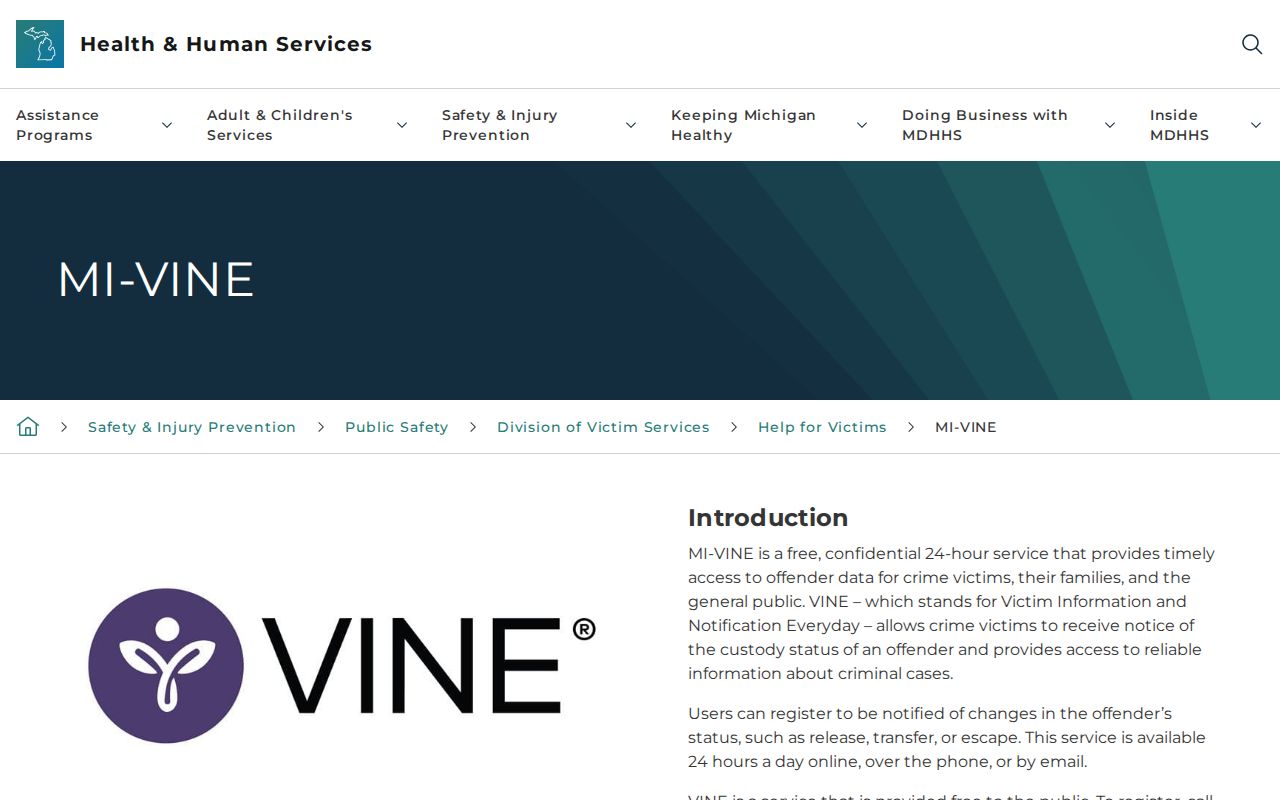
This state page establishes the MI-VINE program, while the contributing agency’s live person record controls the event shown.
Search Osceola County VINELink Records
A specific-person search starts with identity, not an assumed release label. VINELink draws records from contributing agencies, so two records with the same name may concern different bookings or custody systems. Use a full name or identification number, then compare any date of birth or other identifiers displayed. An Osceola jail event and an MDOC event are not interchangeable. A transfer can end the first agency’s record while custody continues with another.
Follow this workflow for one person:
- Open VINELink and select Michigan from the state selection screen.
- Choose the offender or case search made available for Michigan.
- Enter the person’s name or identification number. Avoid using a broad name alone when more identifying details are available.
- Compare possible matches and open the record tied to the correct agency and booking.
- Read the exact custody label and event date shown. Record the wording instead of converting it into a stronger claim.
- When the event is a transfer, identify the next agency and continue through that agency’s system.
- When exact release type or legal disposition matters, confirm the event with the jail, MDOC, or court record.
The VINELink state selection interface is the correct starting point for choosing Michigan.
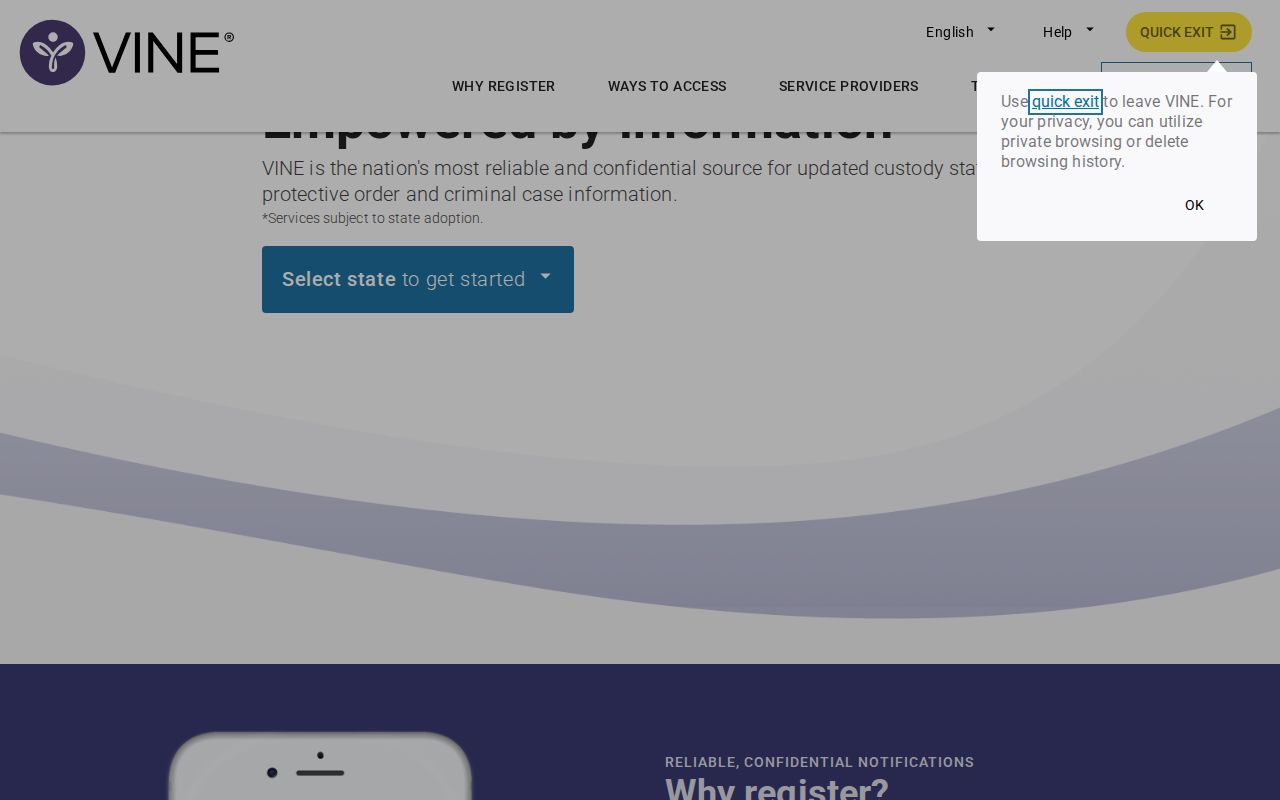
The screenshot shows the national entry point, not proof that a particular Osceola County record is present.
Note: Select a person only after the agency, booking, and available identifiers align with the Osceola County record sought.
Osceola County VINELink Result Fields
Official materials confirm the service’s custody-verification role, but they do not guarantee one universal set of Michigan result labels. Do not hard-code “Out of Custody,” “General Release,” or any other phrase as though every agency uses it. Capture the wording on the live record. The same care applies to field availability. The interface can change, and a county jail feed may not display the same details as an MDOC record.
| Item to record | What it helps confirm |
|---|---|
| Person identifiers shown | Whether the result belongs to the intended person rather than a namesake |
| Contributing agency | Whether the event comes from the Osceola jail, MDOC, or another source |
| Exact custody label | The status language supplied by that agency at the time checked |
| Event type and date, if displayed | Whether the feed reports a release, transfer, escape, or other supported change |
| Facility or location, if displayed | Where the feeder agency associates the person or event |
| Notification option | Whether alert registration is offered for that record |
A release event means the contributing agency reported a supported change. It is not the originating release certificate. For an Osceola County Jail exit, the jail release form can state the date, time, type, and receiving agency. The court file explains bond, dismissal, sentence completion, or probation. For an MDOC record, OTIS distinguishes Parolees, Probationers, Discharged people, and absconders. A VINELink event should be read beside the source that created it.
Register Osceola County Release Alerts
Registration begins from the correct person record. Options may include phone, email, or text according to the live screen. Telephone registration uses a four-digit PIN. That PIN does not act as a password for custody data. It lets the automated call confirm that the intended registrant heard the message and can stop repeat calls for the same event.
Use the following sequence:
- Find and verify the correct person and contributing agency.
- Choose the registration option offered on that record.
- Select phone, email, text, or a supported combination.
- Create a four-digit PIN for telephone registration and keep it private.
- When an automated call arrives, hear the message, then enter the PIN followed by the pound sign.
- Expect email and text alerts to follow their displayed process without the telephone PIN.
- If the PIN is forgotten, use the operator option described by MI-VINE instead of abandoning verification.
The official brochure states that telephone callbacks may continue until the PIN is entered or for a limited callback period. More than one phone or email registration may be allowed. Avoid a switchboard number because the PIN prompt must reach the registrant. Live options control if the screen differs from the brochure.
Keep the source record: an alert reports a feeder-agency event, but a jail form, court order, or MDOC record confirms its legal meaning.
Osceola County VINELink Coverage Limits
VINELink is not a federal inmate locator. For a sentenced federal prisoner, use the Bureau of Prisons Inmate Locator. A past BOP release date means the person is no longer in BOP custody, but it does not rule out supervised release, another agency’s custody, or a new case. The U.S. Marshals Service does not provide an equivalent public released-person name search for federal pretrial custody. In that setting, the federal docket, release order, and actual holding facility are the better sources.
ICE custody also requires its own system. The ICE Online Detainee Locator covers current detention and a limited recent-release window. An Osceola County jail transfer to immigration authorities may close or change a county feed while federal custody continues. Follow the receiving agency rather than describing a transfer alert as community release. No federal or ICE detention facility was verified inside Osceola County.
The Michigan Public Sex Offender Registry is another separate tool. It applies only to people required to register and is not a released-inmate list. A community address does not by itself prove current custody status. Registry absence likewise does not prove that a person remains in custody. Use it only for its defined registry purpose, then verify custody through the jail, OTIS, or VINE as appropriate.
Note: Data timing, agency participation, spelling, transfers, and retention can all produce a missing or delayed VINELink result.
Osceola County Victim Notice Layers
MI-VINE’s general MDOC release alert is not the same as direct crime-victim notice from MDOC. A direct victim seeking parole-hearing and decision notices must separately register with the MDOC Crime Victim Notification Unit at 877-886-5401. A person can use VINELink without publicly disclosing victim status, but enrollment in one service should never be described as enrollment in every statutory notice process.
The Osceola County Sheriff’s Department page advertises victim services and also links a Homeland Security Investigations victim-notification resource. That HSI channel concerns qualifying Department of Homeland Security or immigration matters. It is not the ordinary Osceola County jail MI-VINE service, and it does not establish county participation in VINE. Use HSI notice only when the underlying matter fits that federal program.
These layers answer different questions. MI-VINE supports custody verification and event alerts from participating sources. MDOC’s direct-victim unit handles a separate parole notice track. HSI notification belongs to qualifying federal matters. Keeping the three channels separate prevents a county alert from being mistaken for notice about every later court, parole, or immigration event.
Confirm Osceola County Release Events
Use the agency named on the VINELink record to choose the next source. For an Osceola County Jail event, call the Sheriff’s Department at (231) 832-2288 and ask whether the person remains in county custody. If not, ask for the release date, release type, and receiving agency. A written county FOIA request can seek the inmate release form, transfer record, booking card, and related nonexempt portions.
For a state corrections event, check OTIS. Change the default status filter when looking for a parolee, probationer, or discharged person. Read Current Status apart from Earliest Release Date and Maximum Discharge. Parole means physical prison release under continued MDOC authority. Discharge means the state supervision term reflected by that record has ended. Neither label resolves unrelated cases.
OTIS and VINELink should not be forced to answer each other’s questions. OTIS is the state corrections record for a person under MDOC authority or within its recent discharge scope. VINELink is a custody-notification and corroboration service driven by participating sources. Neither one provides an Osceola County Jail release certificate. If the person served only a local jail sentence, an empty OTIS search is expected. If a VINELink result disappears after a transfer, use the receiving system instead of assuming that all custody ended.
Older events need durable records. A court judgment, jail inmate jacket, release form, or agency discharge record may remain useful after a notification is no longer visible. Request a narrow record using the full name, date of birth if known, approximate booking date, and case number. Ask for the release event and destination when that is the actual question. This makes it easier to distinguish community release from an MDOC, another-county, federal, or immigration transfer.
When the legal reason matters, use the 77th District Court for applicable misdemeanor, bond, and early felony records, or the 49th Circuit Court route for felony disposition and sentence. The complete Osceola County released inmate lookup shows how to follow a jail exit across court, MDOC, federal, and records-request channels. VINELink is strongest as a prompt to verify, not as the final certificate.