
Osceola Projected Release Meaning
A projected date is a planning field, not proof of an actual exit. For a Michigan state prisoner, the key labels are Earliest Release Date and Maximum Discharge. The first usually marks when the Michigan Parole Board gains jurisdiction after the judicial minimum and the lawful sentence calculation. It does not promise parole. The second marks the outer end of the maximum term for the sentence shown, subject to lawful changes and other cases. Current Status must be read before either field.
County custody works on a different record set. A pretrial detainee at Osceola County Jail may leave after bond, a dismissal, a court order, or transfer, yet there is no sentence-based projected date to calculate. A person serving a county-jail sentence may have a calculable end, but the judgment, jail credit, and any later order must be applied by the jail. OTIS does not calculate an Osceola County Jail date.
Find Osceola Release Dates
Start with the system that has custody. Osceola County Jail, MDOC, and federal or immigration agencies keep separate records. A name missing from one system does not resolve the others. The county does not publish a verified current roster or projected-date tool, so a jail inquiry starts with the Sheriff and court. A state-prison inquiry starts with OTIS.
- Identify the custodian. Decide whether the person is in Osceola County Jail, an MDOC prison, federal custody, or another agency's custody.
- For state prison, open OTIS search. Search by the six-digit MDOC number when known, or use enough identifying fields to separate people with similar names.
- Open the correct record. Compare the MDOC number, aliases, descriptors, county, court file, and sentence rows. Read Current Status before the dates.
- For Osceola County Jail, call the Sheriff's Department. Give a full name, date of birth, and approximate booking date, then ask which court order and jail calculation control.
- Check the court trail. The 77th District Court handles misdemeanors and early felony stages. The 49th Circuit Court supplies felony judgments and sentences.
- Confirm the event. Ask for the release form or transfer record once the date arrives. A transfer is continued custody, not community release.
The broader Osceola County released-inmate search explains how to follow a person after a jail exit. For a date question, keep the inquiry narrow: ask for the controlling date label, current status, case number, and source record.
Note: Record the date you checked OTIS because a time-sensitive status or sentence field may change after an agency update.
Osceola OTIS Date Fields
OTIS is the main public route for a person under MDOC jurisdiction. It covers prisoners, parolees, probationers, absconders, and many people discharged within the prior three years. It does not include county-jail-only sentences. The default filter can also hide the record sought, so use Parolees, Discharged, or All when the person's stage is uncertain.
| OTIS field | What it means | What it does not prove |
|---|---|---|
| Current Status | The person's present MDOC category shown in the public record. | That no other agency or case has custody. |
| Earliest Release Date | The point at which Board jurisdiction may begin under the sentence calculation. | That parole was granted or physical release occurred. |
| Maximum Discharge | The maximum endpoint displayed for the MDOC sentence. | That supervision ended sooner or that another sentence is absent. |
| Sentence rows | Offense, court file, county, dates, and minimum and maximum terms when shown. | That one row can be read apart from concurrent or consecutive terms. |
The official OTIS search form shows the identity and status filters used for this lookup.
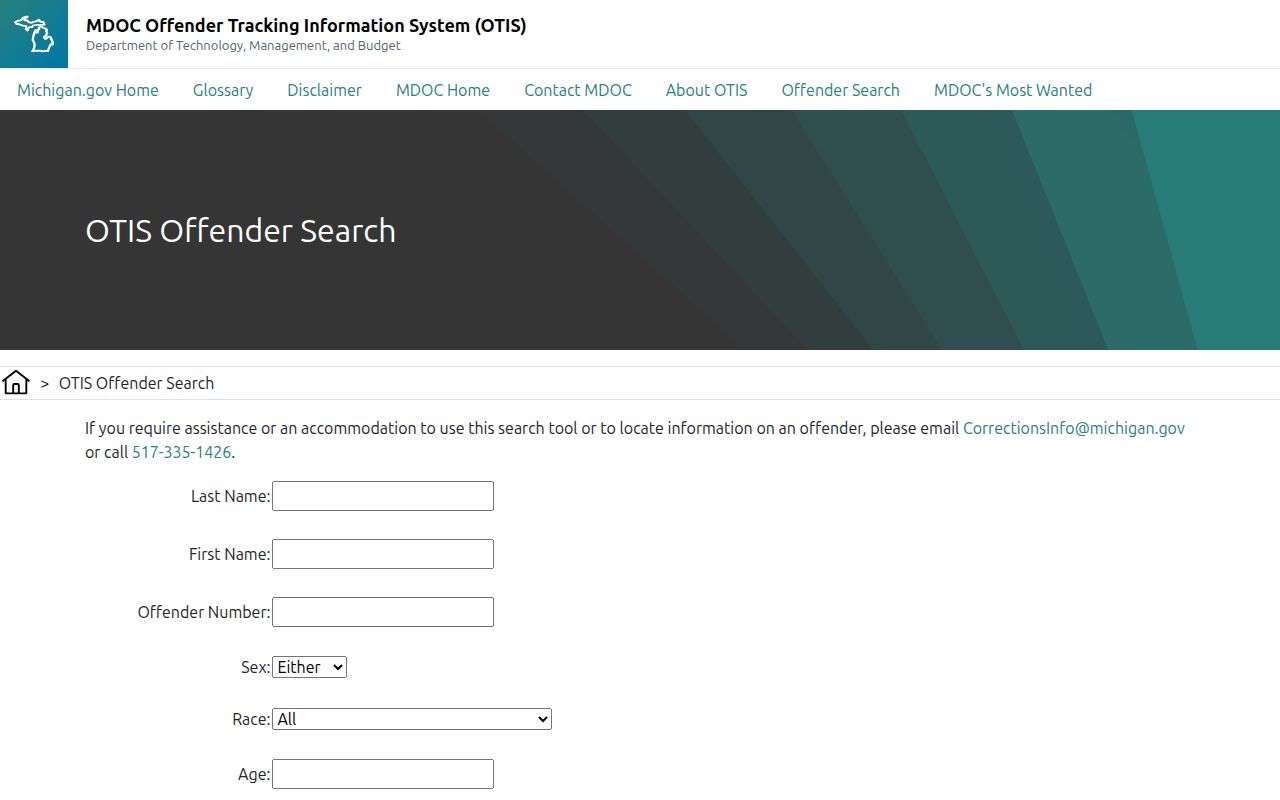
The form confirms that state status and identity fields belong to an MDOC search, not an Osceola County Jail release-date calculation.
An OTIS record can have more than one sentence row. Read every row and note whether the court made the terms concurrent or consecutive. Concurrent terms run at the same time to the extent the judgments allow. Consecutive terms run one after another. A date lifted from one row can therefore be incomplete. New sentences, corrected jail credit, or a later court order can also change the aggregate calculation without making the prior display fraudulent.
OTIS has a limited historical role. Many discharged records remain public for three years after discharge from supervision, but a set-aside or operation of law can remove a record earlier. A no-result search may mean the person served only a county-jail sentence, was discharged outside the public window, used a different spelling, had a record set aside, or was never under MDOC jurisdiction. The sentencing court and a narrow MDOC records request are the durable fallback.
Michigan Release Date Rules
Michigan truth in sentencing is not an 85-percent rule. MDOC explains that covered modern prisoners must serve the full judicial minimum in prison before parole consideration. The rule applies to specified assaultive crimes committed on or after December 15, 1998, and all other covered crimes committed on or after December 15, 2000. Good time, disciplinary credits, drug credits, or education credits do not shorten that judicial minimum for these prisoners.
Michigan uses indeterminate sentences in many cases. That means the minimum and maximum serve different roles. The minimum sets the first point for Board jurisdiction under MCL 791.234, while the maximum provides the outer discharge point. A Board decision remains discretionary. An Earliest Release Date should never be converted into a promise that the person will leave prison that day.
- Judicial minimum
- The minimum term imposed by the court that a covered modern prisoner must serve before parole consideration.
- Parole
- Release from prison into community supervision while MDOC jurisdiction continues.
- Discharge
- The end of the sentence or supervision in the system using that label.
- Detainer
- A notice that another agency may claim custody, affecting destination even when one sentence permits release.
Note: Michigan sentence dates must be read under the law tied to the offense date, not under a general percentage formula.
Older Michigan Credit Regimes
Older eligible sentences can follow different rules. MCL Chapter 800 preserves good-time treatment for eligible crimes committed before April 1, 1987 and disciplinary-credit treatment for some older sentences. MCL 800.34 addresses disciplinary-time prisoners in modern truth-in-sentencing categories. Offense date and sentence type control. Present incarceration alone does not make an old credit table apply.
MDOC Policy Directive 03.01.105 states that covered modern prisoners do not earn good time, disciplinary credits, or drug-law credits against the minimum or maximum. Major misconduct may create disciplinary time for the Board to consider. That is not an earned credit subtracted from the minimum. Multiple offenses may also place different calculation rules in one record, which is why sentence rows and court judgments must be reconciled.
A person may also receive a grant, denial, or defer decision from the Board. MDOC says consideration can start about six months before eligibility. A grant then goes to the Parole Release Unit, which records the decision, date, term, conditions, and placement. At least 28 days ordinarily separate the Board release decision from physical release. “Granted parole” and “released today” are different facts.
A denial can set a later review date. MDOC describes review as generally annual for high or average guideline scores, while a low score can lead to a period of up to two years. A defer delays a final decision. Neither result rewrites the judicial minimum or Maximum Discharge by itself. They change the path through Board review, which is why the Board action and the OTIS status must be checked together.
Osceola Jail Date Calculation
For an Osceola County Jail sentence, use the Judgment of Sentence, days imposed, credit for time served, concurrent or consecutive directions, and any amended order. The jail applies those documents to its lawful calculation. No official public source established an Osceola-specific county good-time percentage, weekend-release rule, or public online calculator. Those details must come from the jail and sentencing court.
The 77th District Court is the usual local route for misdemeanor judgments and bond events. The 49th Circuit Court handles felony judgments and sentences. A felony may leave a trail in both courts because early proceedings occur in district court before the matter moves to circuit court. Court entries explain legal authority, but the jail release form is the stronger source for the exact physical exit time and destination.
If the person has not been sentenced, ask about the next court event and bond rather than requesting a projected sentence date. Bond can authorize a pretrial exit once conditions are met, but another warrant or hold may still prevent community release. Community Corrections may also add day reporting or electronic monitoring. These are current case conditions, not sentence credits, and the court order remains the best source for their terms.
Why Osceola Dates Move
A date can move for a lawful reason or because a public system received new data. Read the reason with the agency record instead of guessing. Even a date that arrives may lead to another facility if a detainer or transfer order controls the next step.
| Change | Possible effect | Best confirmation |
|---|---|---|
| Amended sentence | Changes the controlling term or directions. | Signed court order and updated jail or MDOC calculation. |
| Jail-credit correction | Moves a county sentence endpoint. | Court file and Osceola County Jail calculation. |
| Consecutive case | Adds time after another term. | All sentence rows and judgments. |
| Parole grant, denial, or defer | Changes the expected state-prison path. | Board action, OTIS status, and Parole Release Unit record. |
| Disciplinary time | May affect Board consideration for a covered case. | MDOC record and governing policy. |
| Detainer or hold | Changes where the person goes when one custody term ends. | Release or transfer form and receiving agency. |
When a date is close, check the originating agency again. A pending notification can help track an event, but it does not replace the release document. Michigan's VINELink inmate search may provide a status alert where the contributing agency and record are covered.
Note: A transfer ends Osceola custody but does not end custody as a whole, so always identify the receiving agency.