
Osceola County Parole Versus Probation
Parole and probation both place a person in the community under rules, but they begin in different ways. Parole follows release from a Michigan state prison. The Michigan Parole Board grants it, and the Michigan Department of Corrections Field Operations Administration supervises it. A parolee is physically out of prison but remains under MDOC jurisdiction. Probation is imposed by a court instead of being granted as an early prison release. MDOC may supervise felony probation while the circuit court keeps legal authority. The 77th District Court handles applicable local misdemeanor probation through its own office.
That split matters in Osceola County. An OTIS result marked Parolee points to MDOC. A felony probation result can also point to MDOC. A district misdemeanor order belongs with the 77th District Court probation office, even though both offices are on West Upton Avenue. Community Corrections may administer pretrial day reporting or electronic monitoring, which is neither parole nor ordinary post-sentence discharge. Read the status in the context of its agency and case.
| Status | How it begins | Where to verify |
|---|---|---|
| Parole | Parole Board release from state prison before maximum discharge | OTIS and the MDOC Osceola office |
| Felony probation | Sentence entered by the circuit court | OTIS, MDOC field office, and court file |
| District probation | Order in an applicable 77th District Court case | District probation office and court record |
| Pretrial reporting | Release conditions entered while a case remains pending | Court order and Community Corrections |
- Parole
- Community supervision after release from state prison and before MDOC discharge.
- Probation
- A court sentence served under community rules instead of, or after, a custodial term.
- Discharge
- The end of the supervision term in the system that issued it.
- Absconder
- A person alleged to have stopped reporting or otherwise left supervision without authorization.
Verify Osceola County Post-Release Supervision
The first task is identifying the supervision layer. The MDOC Offender Tracking Information System, known as OTIS, covers Michigan prisoners, parolees, felony probationers, certain absconders, and people discharged from MDOC within its public display period. It does not cover a sentence served only in the Osceola County Jail. It also does not replace the 77th District Court file. A name missing from OTIS can mean local-only supervision, an older discharge, a set-aside, an identity mismatch, or no MDOC case.
Use the following sequence to verify a person without overstating the result:
- Search OTIS by the six-digit MDOC number when known. Otherwise use the full name and enough descriptors to separate similar records.
- Change the default Active Offenders filter. Select Parolees, Probationers, Discharged, or All based on the question.
- Match the MDOC number, aliases, court county, sentence rows, and status. Never choose a record by name alone.
- Read Current Status before reading Earliest Release Date or Maximum Discharge. A past earliest date does not prove that parole was granted.
- For a district misdemeanor case, use the case number and contact the 77th District Court probation office instead of relying on OTIS.
- Confirm a time-sensitive status with the listed MDOC field office or the court that issued the probation order.
The court record supplies legal context. A probation order identifies the court, term, and controlling conditions. A parole order and OTIS status document the state layer. For a broader release check, the Osceola County released inmate search explains how jail, court, MDOC, federal, and transfer records fit together.
Note: OTIS can remain silent about a jail-only Osceola case, so a no-result screen is not proof that supervision ended.
Osceola County MDOC Supervision Office
Osceola County is assigned to MDOC Outstate Region 4, Region 4a. The official Region 4 office directory lists both the county field office and regional operations at the same Reed City address. The field office is the practical contact for state parole and felony probation organization. Staff may direct a caller to the proper unit, though privacy and safety rules can limit details beyond the public OTIS record.
MDOC Osceola Parole/Probation
301 W. Upton Ave.
Reed City, MI 49677-1197
Phone: (231) 832-6162
Region 4a Operations
301 W. Upton Ave.
Reed City, MI 49677
Phone: (231) 832-6179
The directory capture shows the local contact in MDOC’s own office structure.
View the MDOC Region 4 supervision directory before using the office information below.
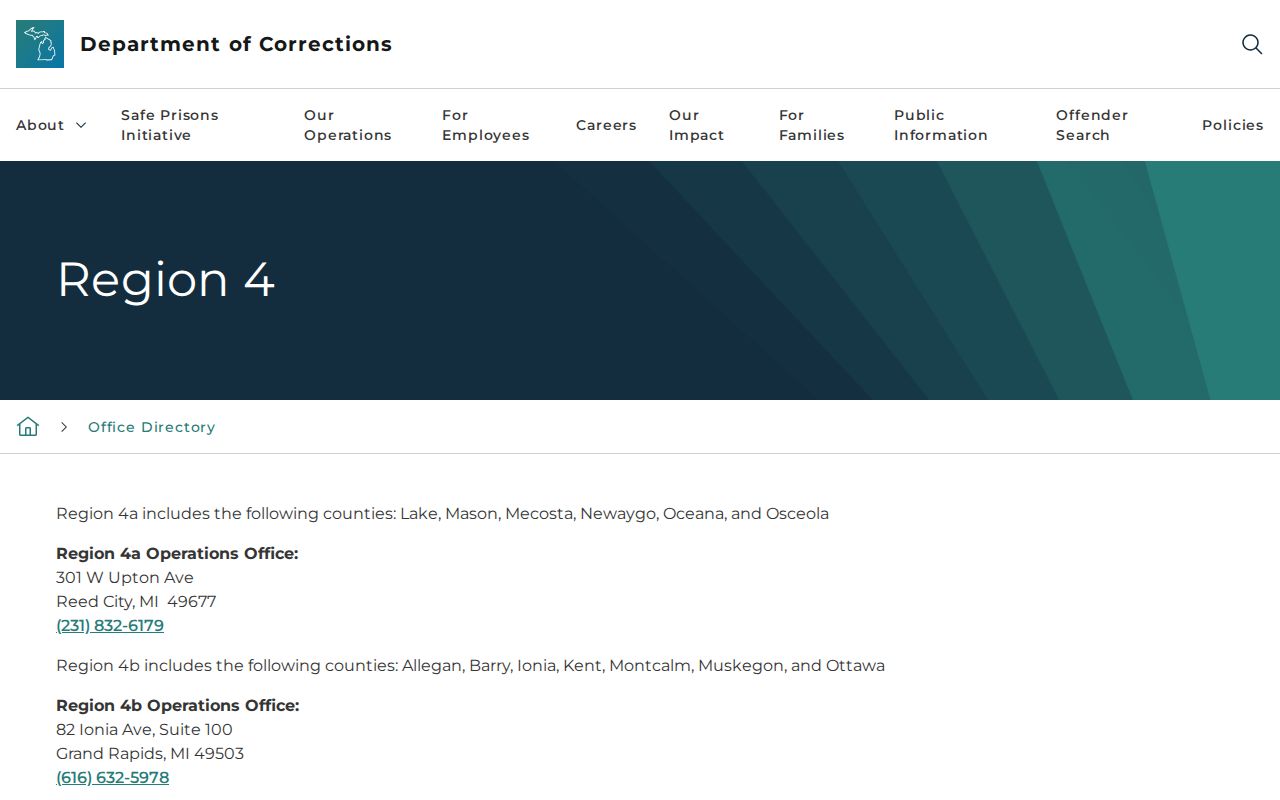
The screenshot helps confirm which state office serves Osceola County, but the live directory controls if contact details change.
Osceola County Local Supervision Programs
Post-custody status in Osceola County extends beyond MDOC parole. The county’s Community Corrections program lists Pre-Trial Release/Day Reporting, Electronic Monitoring, Probation Residential Services, Jail Work Crew, and Community Service Work. These programs show why physical absence from jail is not the same as completion of a case. A person may be outside the jail while reporting, wearing a monitor, completing assigned work, or following a court’s pretrial conditions.
Verify the exact program through the court order and Community Corrections. Do not label a participant a parolee unless MDOC records show parole. Likewise, pretrial day reporting is not probation merely because both involve regular contact. The pending-case docket, release order, and program office together explain what remains in force. A jail release form proves the physical exit, while the court record states the legal conditions.
The official Community Corrections page provides a visual record of the locally offered supervision alternatives.
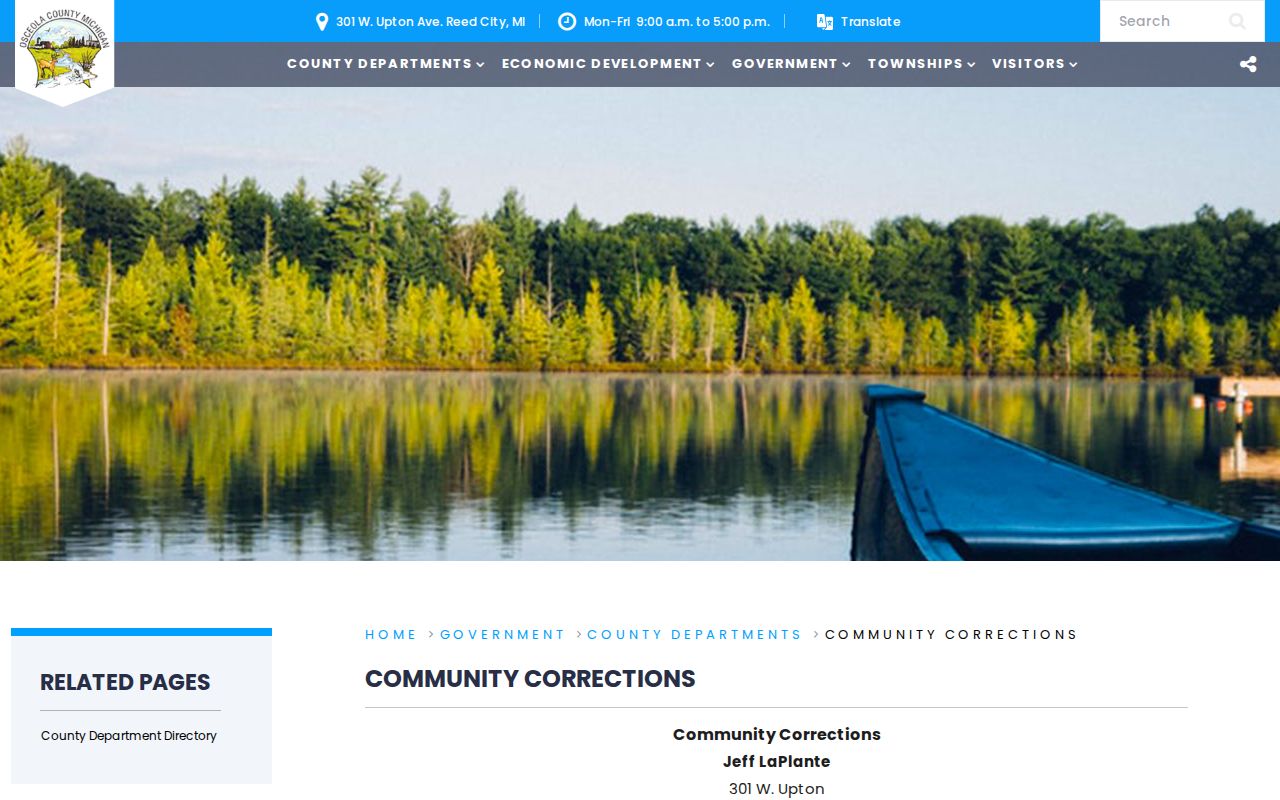
Those named programs make the local post-release landscape distinct from state parole and felony probation.
Osceola County Supervision Office Split
Two supervision offices at 301 W. Upton serve different legal layers. The 77th District Court Probation office lists (231) 832-6160 and identifies Probation Officer Skylar Lopez at option 1. Use that route for applicable district cases and local reporting orders. The MDOC Osceola Parole/Probation Office uses (231) 832-6162 for state parole and felony probation. Region 4a Operations uses (231) 832-6179 for regional administration.
The shared street address does not merge the records. Start with the court level. A misdemeanor probation order in the 77th District Court belongs to district probation. An OTIS parole or felony probation status belongs to MDOC, with the circuit court retaining legal authority over a felony probation sentence. When the case type is unclear, locate the case number and court first. This small step prevents calls to the wrong office and avoids turning a local supervision order into an inaccurate state status.
Choose by record: use OTIS status for MDOC supervision and the 77th District Court order for applicable local probation.
Osceola County Absconders and Warrants
OTIS offers separate Parole Absconders and Probation Absconders filters. An absconder label means alleged failure to remain in contact or comply with supervision. It is not discharge, and it does not prove that every separate case has the same status. MDOC directs information about parole absconders to local law enforcement and publishes an Absconder/Escapee Tip Line at 517-755-0855. Current person-level OTIS data is more useful than an aggregate report when the question concerns one named person.
A warrant is a court or agency command, not a synonym for absconder. The 77th District Court may issue warrants within its jurisdiction, while an MDOC response to an alleged parole violation follows the state supervision process. A person may have a district warrant without an OTIS absconder label, or an MDOC absconder status tied to state supervision. Check the docket or clerk for a local warrant question. Never infer that a warrant was cleared because the person is no longer on a jail list.
Conditions and alleged violations must also stay tied to their source. MDOC records the parole term and conditions after a Board grant, while a probation court enters the controlling probation order. Community Corrections administers listed local programs under the relevant court arrangement. A missed report, new case, or other alleged breach does not have one automatic outcome across all three systems. Use the current OTIS status for the state layer, the signed court order and docket for district probation, and the proper program contact for local reporting. If a person is taken into custody, confirm which warrant, violation process, or separate case caused that custody before connecting it to parole or probation.
Note: An absconder or warrant result signals unresolved authority and must never be described as normal release from supervision.
How Osceola County Supervision Ends
Use a three-stage model. First, prison or jail means physical custody continues. Second, parole, probation, pretrial reporting, or electronic monitoring can place the person in the community while legal control remains. Third, discharge or completed status means the relevant supervision term has ended. The label applies only to the agency and case that produced it. A person can be discharged from one sentence while held or supervised on another.
For MDOC, successful completion of parole or felony probation can lead to discharge. OTIS may show recently discharged people, and Maximum Discharge is the maximum end shown for the displayed state sentence. It is not a universal end date for unrelated cases. For district probation, the court file and final order are the better record of completion. Michigan FOIA may provide nonexempt agency records, but public visibility can change after the OTIS display period or a lawful set-aside.
Keep the source and retrieval date with any status note. If a current decision matters, confirm it with MDOC or the issuing court. Release from a building and discharge from legal control are separate events, and accurate Osceola County supervision verification keeps them separate.