
Understanding Osceola County Releases
A release from the Osceola County Jail means the Sheriff no longer holds the person at that jail. It does not always mean that all custody or legal control has ended. A defendant may go home on bond, enter pretrial reporting, begin probation, finish a jail term, or move to another agency. A transfer to the Michigan Department of Corrections, another county, a federal custodian, or immigration authorities ends Osceola County Jail custody while confinement continues elsewhere.
That distinction controls the search. The jail release form establishes the physical exit and may name the destination. The court order explains the legal basis. A receiving agency documents continued custody, while a supervision record shows conditions after physical release. An MDOC parole record is different again: the person has left prison but remains under state jurisdiction. “Discharged” ordinarily means the relevant MDOC sentence or supervision has ended.
- Release
- A physical exit from the facility, including an exit by transfer.
- Parole
- Community service of a state sentence under MDOC supervision after prison.
- Probation
- A court sentence served in the community under stated conditions.
- Discharge
- The end of the sentence or supervision in the system using that label.
Important: A missing jail name does not show where a person went. Confirm the release type and receiving agency.
Osceola County Release Paths
Osceola County released inmates follow several documented paths. Precise wording matters because “release” can describe both a return to the community and a handoff between agencies. The record should identify the event without assuming the person is free of every case, hold, or term of supervision.
| Release path | What it means | Next source |
|---|---|---|
| Bond or pretrial order | The person left jail while the case remained open. | 77th District Court and Community Corrections |
| Time served or completed term | The jail term was satisfied. | Judgment, jail calculation, and release form |
| Probation | Custody ended while court supervision began or continued. | District probation or OTIS for felony probation |
| Parole | A state prisoner left prison under MDOC control. | OTIS, parole order, and local MDOC office |
| Transfer | Osceola custody ended but another agency took custody. | Receiving sheriff, MDOC, BOP, or ICE |
| Dismissal or acquittal | A court ruling removed that custody basis. | Signed order and jail exit record |
A death ends custody for a different reason and must never be described as a community release. Probation and parole are not interchangeable. The first comes from a court sentence; the second is a conditional state-prison release authorized through the Michigan Parole Board process.
Osceola County Release Record Fields
A focused Osceola County release-record request should name the fields needed to resolve the custody event. Michigan’s local law-enforcement retention schedule describes an inmate jacket that can include booking cards, mug shots, sentencing records, property-release forms, transfer papers, court documents, inmate release forms, bonds, and warrants. The schedule describes record classes, not a promise that every jacket contains every item or that every part is open without redaction.
| Field | What it shows |
|---|---|
| Name and identifiers | Links the event to the correct person. |
| Booking or inmate number | Connects the exit to the correct jail stay. |
| Release date and time | Shows when jail processing ended. |
| Release type | Distinguishes bond, completion, court order, or transfer. |
| Receiving agency | Shows whether custody continued elsewhere. |
| Case or bond reference | Connects the event to the court trail. |
| Property acknowledgment | May document exit processing and property handling. |
Does a release form prove the case ended? No. It proves that the jail processed an exit. A bond case, transfer, probation order, or another hold may remain active, so court and receiving-agency records still matter.
Request Osceola County Release Records
No verified online Osceola County release archive was found. Written confirmation therefore comes through the Sheriff and county FOIA process. A narrow request reduces identity errors and avoids asking for unrelated medical, victim, juvenile, or security material.
- Use the Osceola County forms center and current public-records request form.
- Give the full name, date of birth if known, approximate booking date, and Osceola County Jail.
- Ask for the inmate release form, exact release date and time, release type, and receiving agency.
- Add a booking card, bond or transfer paper, property acknowledgment, or photograph only when needed.
- Request electronic delivery and separable nonexempt material when lawful redaction is needed.
The Sheriff’s Department is at 325 W. Upton Ave., Reed City, MI 49677, and its main line is (231) 832-2288. County FOIA Coordinator Tim Ladd is at 602 W. Upton Ave., Reed City, MI 49677; phone (231) 832-6196, fax (231) 832-6197, and email oscadmin@osceolacountymi.gov.
Under MCL 15.235, a public body generally has five business days after legal receipt to grant, deny, partly grant, or issue an extension notice. One extension may add up to ten business days. This governs the response, not necessarily final production. Fees may include categories allowed by MCL 15.234 and the county’s current procedures. Ask for an estimate rather than assuming a set charge.
Osceola Release Records and FOIA
Michigan’s Freedom of Information Act, MCL 15.231 and following, supplies the public-record route. An agency may withhold exempt content under MCL 15.243, but public and exempt information can often be separated. Review the stated exemption and county appeal procedures when a request is denied or a fee appears excessive.
Michigan General Schedule 11, item 11.210, retains a jail inmate jacket until release plus ten years. Other record classes have different periods. Retention is not disclosure, and neither requires web publication. The current approved schedule should be checked before relying on a deadline.
Set-aside and sealing rules can change public visibility. Under MCL 780.621, 780.621d, and 780.622, eligible Michigan convictions may follow petition-based or automatic paths. A set-aside removes a conviction from ordinary public view but does not erase every nonpublic government record. Juvenile, sealed, and protected records need separate treatment.
Osceola Jail Fee History
A December 2021 county board packet documents a local pay-to-stay and work-release proposal. It shows that charges and collection terms were under review, but it is not a current fee schedule. Historical rates in that packet should not be quoted as today’s amount.
Ask the Osceola County Jail for the adopted current rate, an itemized balance, and the approved payment route. The Sheriff page links a payment vendor for commissary, bond, and bills, but that vendor’s presence does not establish the legal basis or value of a particular charge. A records estimate under FOIA is a separate issue governed by county policy and state law.
Note: Dated county proposals document local history, not a present obligation or current records-request price.
Find Released Osceola County Inmates
The correct lookup begins by identifying the custody system. OTIS does not include a jail-only sentence, and the county has no verified public roster or recent-release feed. A methodical search follows the record from Osceola County Jail to the court, supervision office, or receiving custodian.
- Call the Osceola County Sheriff at (231) 832-2288 and ask about current custody, the release date and type, or a receiving agency.
- Check the 77th District Court for misdemeanors, bond, and early felony events, then the 49th Circuit Court for a felony disposition or sentence.
- Contact Community Corrections when pretrial reporting, day reporting, or electronic monitoring may apply.
- Search MI-VINE for the exact person and agency record, recognizing that participation, timing, or transfer can affect results.
- Use OTIS when the person entered MDOC custody or is on state parole or felony probation.
- File a focused county FOIA request when written proof of the exit, disposition, or destination is needed.
- Follow any transfer into the receiving system, including another sheriff, MDOC, BOP, or ICE.
Roster limit: Absence from a live custody list would not prove community release. A transfer, delay, spelling issue, or new booking number can explain it.
OTIS Osceola Release Search
The Michigan Offender Tracking Information System is the right source for a person under MDOC jurisdiction. It is not an Osceola County Jail release list. Search by the six-digit MDOC number when known, or use enough name and identifying data to distinguish matches. Change the default Active Offenders filter when looking for someone physically released from prison.
| OTIS field | Search or result use |
|---|---|
| Last and first name | Starts a search when the MDOC number is unknown. |
| Offender number | Provides the strongest direct match when available. |
| Sex, race, and age | Help narrow common-name results. |
| Offender Status | Includes Prisoners, Parolees, Probationers, Discharged, absconder, and All filters. |
| Current Status | Separates prison, parole, probation, and discharge. |
| Sentence rows | May show court, county, offense, Earliest Release Date, and Maximum Discharge. |
A Parole status usually means physical prison release with supervision still active. Discharged means MDOC jurisdiction ended for the displayed case. Earliest Release Date is not a promise. It marks the point when the Parole Board may gain jurisdiction under the governing calculation. OTIS generally displays discharged people for three years, so older confirmation may require a court file or MDOC request.
The OTIS search screen shows the filters and person-search fields used for an Osceola County state record.
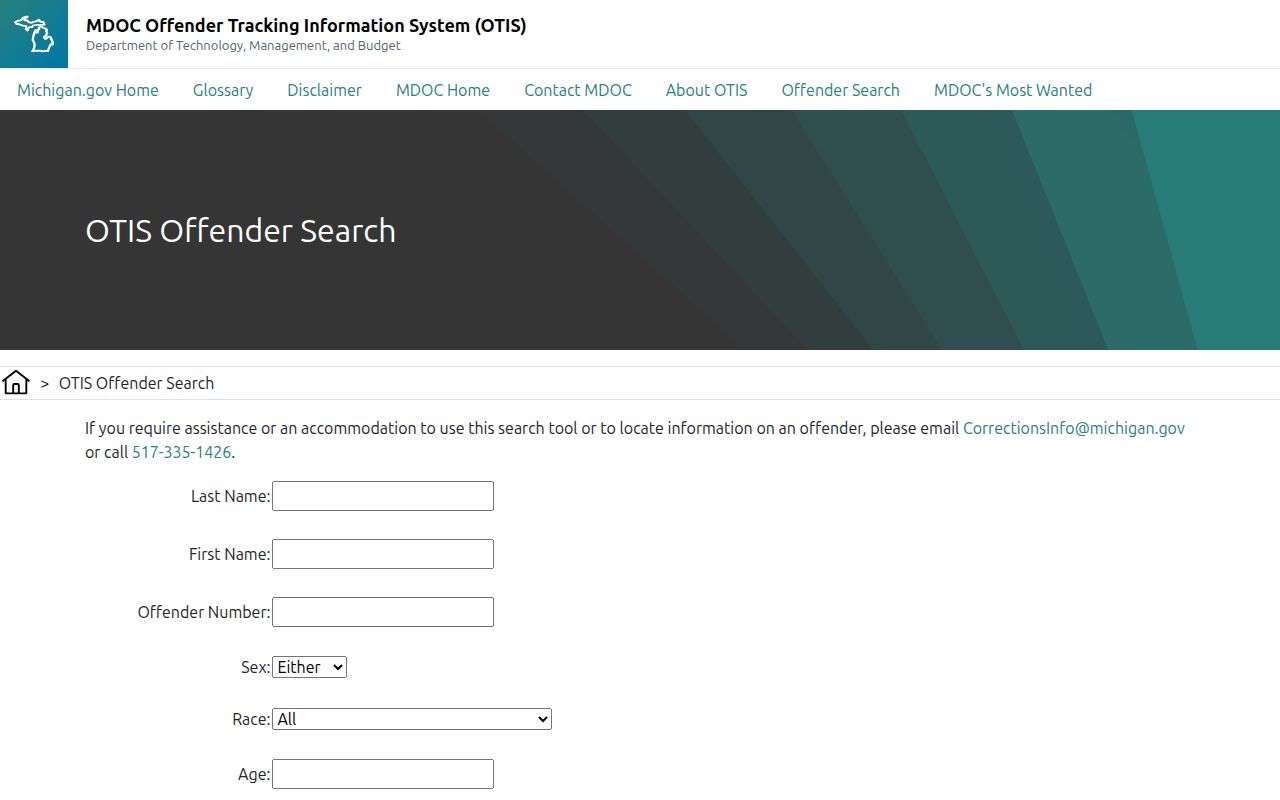
The screen reinforces why Active Offenders must be changed when parole or recent discharge is the issue.
Osceola Recent Release Limits
The official county and Sheriff sweep found no live inmate search, rolling 24-hour list, rolling 72-hour list, released-person archive, or booking-photo roster for Osceola County, Michigan. Results from Osceola County in Iowa or Florida are unrelated. This absence concerns web publication, not internal jail records.
For a recent event, call the jail, examine the court entry, search VINE, and ask Community Corrections whether a court program applies. A written request can seek the exact release entry or transfer destination. The Osceola County 24-hour release workflow organizes same-day checks without pretending a public feed exists.
Internal retention can far exceed online visibility. Michigan’s schedule keeps the inmate jacket after release, while no Osceola web posting may ever have existed. A name missing online says little about whether the underlying record remains.
Osceola Post-Release Program Layers
Osceola County has three distinct post-custody layers. MDOC Field Operations supervises state parole and felony probation. The 77th District Court Probation office handles applicable local district cases. Community Corrections lists Pre-Trial Release/Day Reporting, Electronic Monitoring, Probation Residential Services, Jail Work Crew, and Community Service Work.
These programs show why release from jail is not discharge. A person can be outside the building and still report, wear a monitor, comply with bond terms, serve probation, or remain on parole. Check the court level and OTIS status before choosing an office. Although the district probation and MDOC offices are both at 301 W. Upton Avenue, they are not interchangeable.
OTIS filters identify Parolees, Probationers, Parole Absconders, and Probation Absconders. An absconder label alleges a failure to remain in contact; it does not mean supervision ended. District warrants belong to the court trail. Successful completion leads to discharge in the relevant system.
Osceola Pretrial Release Conditions
Osceola County Community Corrections expressly operates pretrial release and day reporting as well as electronic monitoring. A defendant may leave the jail while the criminal case and court conditions remain active.
Read the bond or release order first. Then confirm reporting requirements with Community Corrections and the release event with the jail. Describe the result as bond or pretrial release, not sentence completion, unless the court supports that conclusion. If a monitor or reporting term later ends, confirm the change with the responsible office rather than inferring it from physical location.
Can someone be released and still monitored? Yes. Physical release and legal supervision are separate facts in Osceola County.
Osceola Release Court Trail
Osceola County has a split criminal-court trail. The 77th District Court handles misdemeanors, arraignments, preliminary proceedings, bond functions, and warrants within its jurisdiction. A felony can then move to the 49th Circuit Court for disposition and sentencing. A complete release check may require both stages.
The district docket can show the bond or early order that made release possible. The circuit record can show a felony judgment, sentence, dismissal, or later amendment. Neither necessarily certifies the exact time a person left jail. Pair the signed order with the Sheriff’s release form when exact physical processing matters.
The 49th Circuit MiCOURT search is a starting point, while the clerk supplies the authoritative signed document when the summary is thin. A court entry may also expose a new hold or consecutive case that changes the apparent release path.
Osceola Release Alerts and Transfers
MI-VINE provides custody verification and event alerts through VINELink or its telephone service. County-jail events can include release, transfer, or escape for participating agencies. No Osceola-specific participation statement was found, so select Michigan and test the exact person and agency record. VINE corroborates an event; it is not the release certificate.
For state prisoners, VINELink offers a general MDOC release alert. Direct victims seeking parole-hearing or decision notices use the separate MDOC Crime Victim Notification Unit. A transfer alert requires follow-up because the person may remain confined by a receiving agency.
Federal paths use other tools. The BOP Inmate Locator covers federal inmates released after 1982 and can show release date and location or status. ICE’s locator covers current detainees and people released from ICE custody within the prior 60 days. USMS has no comparable public name-search release tool, so a federal pretrial case calls for the federal docket and holding facility. No federal or ICE detention site was verified inside Osceola County.
Osceola Custody Status Sources
Use the system tied to the custody event. A current-custody tool answers who is held now, while a release record explains the completed exit. State and federal locators cover only their own jurisdictions.
| Question | Best source | Main limit |
|---|---|---|
| Still in Osceola jail? | Sheriff telephone confirmation | No verified public live roster |
| How did the jail stay end? | Release form, court order, transfer paper | May require FOIA and redaction |
| Released from state prison? | OTIS Current Status and sentence fields | Not for jail-only stays |
| Federal release? | BOP locator and federal docket | Does not resolve other custody |
| Recent ICE release? | ICE ODLS and help line | Released-person window is limited |
When sources conflict, prefer the originating record and confirm time-sensitive facts with the responsible office. A transfer ends one agency’s custody but should be traced until the receiving status is clear.
Osceola County Detention Facility
The research verified one adult detention facility in the county: the Osceola County Jail, operated through the Sheriff’s Department in Reed City. It holds people at different stages, including pretrial detainees, people serving county-jail sentences, and people awaiting hearings or transfers.
A community exit can lead to bond conditions, probation, or Community Corrections. A transfer may lead to MDOC, another county, federal custody, or immigration custody. The release form and court case identify which path applies. No state prison, BOP prison, or ICE detention center was verified within Osceola County, though a person convicted locally may be held elsewhere.
Police-station holding cells were not treated as separate destinations because no separately operated municipal jail with its own release-record system was established. Juvenile facilities and records are outside the adult jail map and require separate confidentiality analysis.
Note: Call the Osceola County Jail before travel because its published walk-in service hours are not identified as release-processing hours.